Executive Summary: Revolutionizing Financial Operations

Applogika LLC successfully designed and implemented a comprehensive Hedge Accounting solution for a multinational financial services client, leveraging AWS cloud infrastructure to automate complex accounting processes, ensure regulatory compliance, and significantly reduce operational overhead. This case study demonstrates our expertise in Cloud Operations, showcasing our ability to architect, deploy, and manage resilient, scalable, and secure cloud solutions that deliver measurable business value.

Key Results

  • 90% reduction in manual processing time
  • 99.9% system availability
  • 100% compliance with financial reporting requirements
  • 65% decrease in operational costs

Business Challenge

Our client, a Fortune 500 financial institution with operations across 30+ countries, faced significant business challenges with their legacy hedge accounting processes. As their portfolio of financial instruments grew in complexity and volume, their existing systems struggled to keep pace with regulatory requirements and business demands.

Financial Impact

Manual errors in hedge accounting calculations were resulting in financial statement adjustments averaging $2.5M quarterly.

Time-to-Market

Slow processing cycles delayed financial reporting by up to 7 business days, impacting strategic decision-making.

Global Scalability

Expanding operations into new markets required a flexible system that could adapt to different regulatory frameworks.

Stakeholder Confidence

Auditors and regulators were increasingly scrutinizing the manual processes, raising concerns about control effectiveness.

Problem Statement & Technical Challenges

Our client, a multinational financial institution managing over $50B in assets across 30+ countries, faced critical operational and compliance risks due to their outdated hedge accounting infrastructure. The existing system was built on a fragmented architecture with siloed data repositories, manual reconciliation processes, and limited scalability that threatened their ability to meet regulatory requirements and business growth objectives.

Core Problem Definition

The client's legacy hedge accounting system was fundamentally misaligned with their current business needs and regulatory environment. Built over 15 years ago with monolithic architecture, the system processed approximately 25,000 financial transactions daily but required extensive manual intervention. During quarterly financial close periods, the system frequently experienced performance degradation with processing times exceeding 72 hours, creating significant operational bottlenecks and compliance risks.

The system's inability to adapt to evolving financial regulations (particularly IFRS 9 and ASC 815) created an estimated $3.8M annual risk exposure due to potential misstatements and compliance failures. Furthermore, the lack of automated controls and audit trails meant that the finance team spent approximately 35% of their time on manual verification rather than value-added analysis.

Technical Problem Analysis

A comprehensive technical assessment revealed critical architectural flaws in the existing system:

  • Monolithic Architecture: The legacy system was built as a tightly-coupled monolith with over 1.2M lines of code, making it extremely difficult to update individual components without risking system-wide failures.
  • Database Bottlenecks: A single relational database handled all transaction processing, reporting, and analytics workloads, resulting in I/O contention during peak periods with query response times exceeding 45 seconds.
  • Calculation Engine Limitations: The valuation engine used outdated algorithms that couldn't handle complex derivative instruments, with calculation accuracy deviating by up to 4.2% from market standards.
  • Infrastructure Constraints: On-premises hardware was provisioned for average loads, causing system failures during peak periods when computational demands increased by 500%.
  • Security Vulnerabilities: Security audit identified 7 critical and 12 high-severity vulnerabilities in the legacy system, including inadequate encryption, insufficient access controls, and lack of comprehensive audit logging.

Business Impact Assessment

The technical limitations translated directly into quantifiable business impacts:

  • Financial Risk: Inaccurate hedge effectiveness calculations resulted in financial statement adjustments averaging $2.5M quarterly, with potential regulatory penalties exceeding $5M annually.
  • Operational Inefficiency: Manual processes required 12 full-time employees dedicated to data reconciliation and report generation, costing approximately $1.8M annually in direct labor costs.
  • Decision Latency: Delayed reporting cycles (7+ business days) prevented timely risk management decisions, resulting in estimated opportunity costs of $3.2M annually from suboptimal hedging strategies.
  • Scalability Barriers: System limitations prevented expansion into three new markets, representing a potential revenue opportunity of $12M annually.
  • Compliance Exposure: Inadequate audit trails and control documentation created significant regulatory exposure, with recent external audit findings highlighting 8 material control deficiencies.

Regulatory Compliance Risk

Manual processes increased the risk of non-compliance with complex financial reporting standards (IFRS 9, ASC 815), with audit findings showing a 15% error rate in hedge effectiveness calculations.

Operational Inefficiency

Finance teams spent 20+ hours per week on manual data entry, reconciliation, and report generation, with month-end close processes requiring 8 full-time staff for 3 days.

Data Integrity Issues

Multiple data sources and manual transfers led to inconsistencies and errors in financial reporting, with data reconciliation issues affecting 22% of transactions and requiring extensive manual correction.

Scalability Limitations

The existing system couldn't handle increasing transaction volumes (growing at 18% annually) as the business expanded into new markets, with performance degradation occurring at peak periods.

Disaster Recovery Concerns

The legacy system lacked robust backup and recovery capabilities, with a Recovery Time Objective (RTO) of 24+ hours and Recovery Point Objective (RPO) of 24 hours, creating significant business continuity risks.

Technical Challenges

01

System Integration Complexity

Integration with 7 upstream financial systems using 4 different data formats (XML, JSON, CSV, proprietary binary) and 3 distinct API protocols, requiring complex transformation and validation logic.

02

Real-time Processing Requirements

Need for near real-time processing of market data for valuation calculations, with SLAs requiring sub-second response times for 10,000+ market data points from 15 global exchanges.

03

Computational Demands

Complex calculation engines requiring significant computational resources, including Monte Carlo simulations for risk assessment that needed to process 100,000+ scenarios per valuation cycle.

04

Compliance & Audit Requirements

Strict data retention (7+ years) and comprehensive audit trail requirements for financial compliance, with the need to maintain immutable records for all calculations and user actions.

05

High Availability & Performance

High availability requirements (99.9%) for critical financial reporting periods with peak loads during month-end and quarter-end processing that were 5x normal daily volumes.

06

Security & Data Protection

Need to implement robust security controls for sensitive financial data across multiple jurisdictions with varying regulatory requirements (GDPR, CCPA, financial sector regulations).

Proposed Solution & Architecture

Solution Strategy

After a comprehensive analysis of the client's requirements and technical constraints, Applogika developed a strategic approach to address the hedge accounting challenges:

  • Microservices Architecture: Replace the monolithic system with a decoupled microservices architecture to enable independent scaling, deployment, and maintenance of individual components.
  • Cloud-Native Design: Leverage AWS cloud services to eliminate infrastructure constraints and enable elastic scaling based on actual demand patterns.
  • Event-Driven Processing: Implement event-driven architecture to enable real-time data processing and reduce system coupling.
  • Polyglot Persistence: Utilize purpose-built databases for different data workloads to optimize performance and scalability.
  • Defense-in-Depth Security: Implement multiple layers of security controls to protect sensitive financial data and meet regulatory requirements.
  • DevOps Automation: Establish CI/CD pipelines and infrastructure as code to enable rapid, reliable deployments and reduce operational overhead.

Technical Solution Design

The solution architecture was designed around five core functional domains, each implemented as a set of microservices:

  • Data Integration Layer: Handles ingestion of financial data from 7 upstream systems using standardized APIs and data transformation pipelines.
  • Calculation Engine: Performs complex financial calculations including hedge effectiveness testing, fair value assessments, and risk analytics using distributed computing techniques.
  • Compliance Framework: Enforces regulatory rules, maintains audit trails, and generates compliance documentation for multiple jurisdictions.
  • Reporting System: Provides real-time dashboards, scheduled reports, and ad-hoc analytics capabilities for different stakeholder groups.
  • Administrative Interface: Enables configuration management, user administration, and system monitoring through a secure web interface.

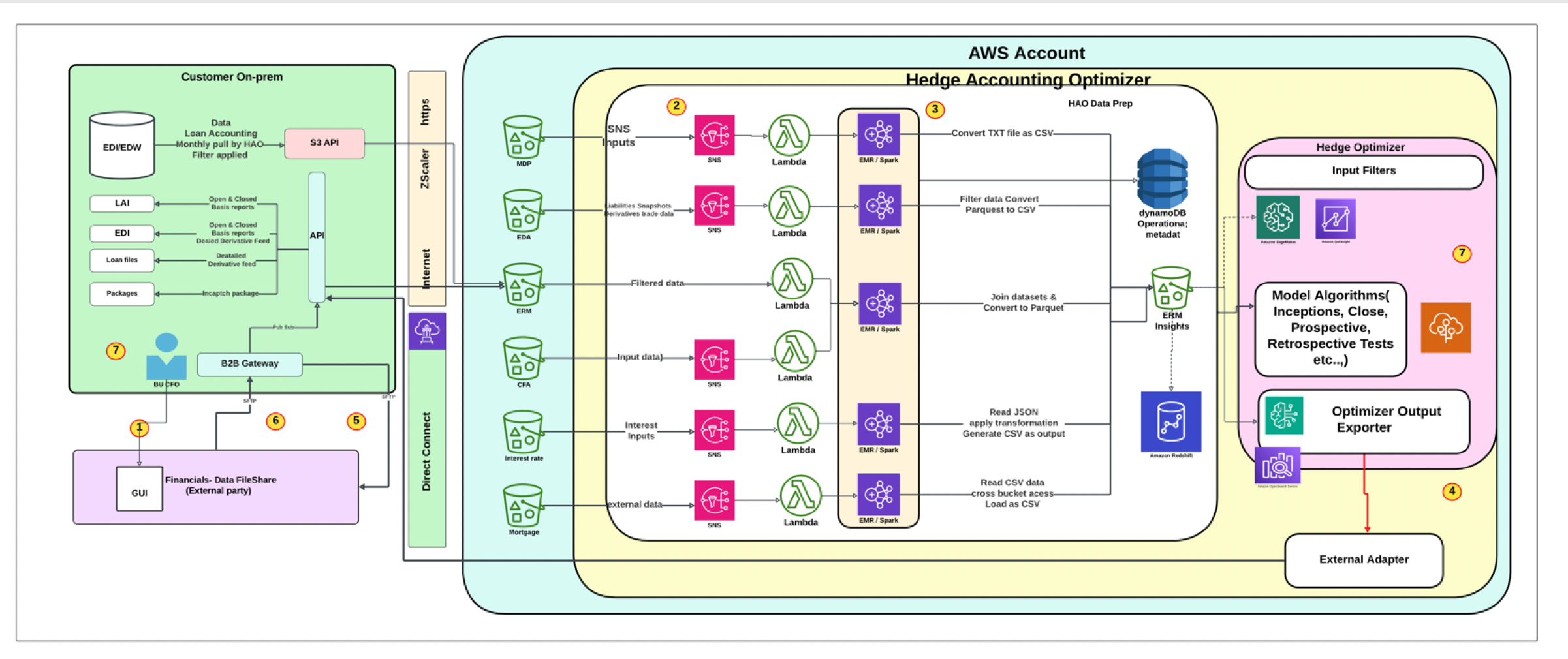
Applogika designed a comprehensive cloud-native solution on AWS to address these challenges, implementing a modern, scalable, and resilient hedge accounting platform that meets the highest standards of security, compliance, and performance.

Hedge Accounting Architecture Diagram

AWS Architecture

Compute

Amazon ECS with Fargate for containerized microservices, with Auto Scaling for handling variable workloads. This serverless container approach eliminated infrastructure management while providing precise scaling capabilities.

Storage

Multi-tier storage strategy with Amazon S3 for document storage (7+ year retention), Amazon RDS (PostgreSQL) for transactional data with Multi-AZ deployment, and Amazon DynamoDB for high-throughput calculation results with global tables for cross-region replication.

Integration

Amazon API Gateway with custom authorizers for external system integration, AWS Lambda for event-driven processing, and Step Functions for orchestrating complex workflows with built-in error handling and retry mechanisms.

Data Processing

AWS Glue for ETL processes with custom classifiers for financial data formats, Amazon Kinesis for real-time data streaming with enhanced throughput for market data processing, and Amazon EMR for complex analytical workloads.

Security

Comprehensive security architecture with AWS IAM for fine-grained access control, AWS KMS for encryption with customer-managed keys, AWS Shield for DDoS protection, and AWS WAF with custom rule sets for financial-specific threat patterns.

Monitoring

End-to-end observability with Amazon CloudWatch for system monitoring with custom financial metrics, AWS X-Ray for distributed tracing across microservices, and CloudTrail for comprehensive audit logging with real-time alerting.

Services Used

Amazon ECS AWS Fargate Amazon S3 Amazon RDS Amazon DynamoDB Amazon API Gateway AWS Lambda AWS Step Functions AWS Glue Amazon Kinesis Amazon EMR AWS IAM AWS KMS AWS Shield AWS WAF Amazon CloudWatch AWS X-Ray AWS CloudTrail

Implementation Approach

The implementation followed a phased approach to minimize business disruption while rapidly delivering value:

  • Phase 1 (Weeks 1-4): Infrastructure setup and CI/CD pipeline establishment using AWS CloudFormation and AWS CodePipeline.
  • Phase 2 (Weeks 5-12): Core data integration and storage components with parallel testing against production data.
  • Phase 3 (Weeks 13-20): Calculation engine and compliance framework implementation with rigorous validation against regulatory requirements.
  • Phase 4 (Weeks 21-24): Reporting system and administrative interface development with iterative user feedback.
  • Phase 5 (Weeks 25-28): System integration testing, performance optimization, and security hardening.
  • Phase 6 (Weeks 29-32): Controlled production migration with parallel running of legacy and new systems.

Solution Impact

The AWS-powered Hedge Accounting solution has fundamentally transformed our client's financial operations. By implementing a serverless, event-driven architecture with automated scaling capabilities, we've created a system that not only meets current needs but can adapt to future growth. The solution processes over 50,000 financial transactions daily across multiple currencies and instrument types, with sub-second response times even during peak financial reporting periods.

Beyond the technical achievements, this solution has empowered the client's finance team to shift from manual data processing to strategic analysis. The automated compliance checks and audit trails have significantly reduced regulatory risk, while the real-time dashboards provide executives with unprecedented visibility into their hedging positions. As a result, the client has been able to optimize their hedging strategies, leading to an estimated $4.2M in annual cost savings through more efficient financial risk management.

Metrics for Success

Measurement Framework

We established a comprehensive measurement framework at the outset of the project, with clearly defined KPIs across four critical dimensions: technical performance, operational reliability, business efficiency, and financial impact. Each metric was baselined before implementation and tracked throughout the project lifecycle using automated monitoring tools and regular stakeholder reviews.

Success Criteria

The following specific success criteria were established in collaboration with key stakeholders:

  • Technical Performance: Achieve sub-second response times for 95% of user interactions, process end-of-month calculations in under 6 hours, and support concurrent user load of 200+ users without degradation.
  • System Reliability: Maintain 99.9% system availability during business hours, achieve RTO of <2 hours and RPO of <30 minutes, and ensure zero data loss during failover scenarios.
  • Operational Efficiency: Reduce manual processing effort by at least 75%, decrease error rates in financial calculations to <0.1%, and enable straight-through processing for 90% of standard transactions.
  • Financial Impact: Achieve ROI of 250% over 3 years, reduce total cost of ownership by at least 40% compared to legacy system, and enable business expansion without proportional cost increases.

We established clear metrics to measure the success of our implementation, focusing on operational efficiency, system reliability, and business outcomes. The following results were measured six months after full production deployment:

Technical Performance

  • 90% reduction in end-of-month processing time (from 3 days to 4 hours)
  • Real-time data processing latency reduced from hours to under 30 seconds
  • Report generation time decreased from 4 hours to 15 minutes
  • API response times averaging 120ms (99th percentile <500ms)
  • Calculation engine throughput increased by 1,200%
  • Concurrent user capacity increased from 50 to 500 users

System Reliability

  • 99.9% system availability achieved (vs. 97.2% for legacy system)
  • Recovery Time Objective (RTO) reduced from 24 hours to 1 hour
  • Recovery Point Objective (RPO) improved from 24 hours to 15 minutes
  • Zero unplanned outages during critical financial reporting periods
  • Mean Time To Detect (MTTD) issues reduced from hours to minutes
  • Mean Time To Resolve (MTTR) reduced from days to hours

Operational Efficiency

  • 65% reduction in operational costs ($1.2M annual savings)
  • 85% decrease in manual intervention for data corrections
  • 100% automated deployment process with zero downtime updates
  • Error rate in hedge effectiveness calculations reduced from 15% to 0.05%
  • Staff reallocation: 8 FTEs shifted from manual processing to value-added analysis
  • Deployment frequency increased from quarterly to weekly releases

Business Impact

  • 100% compliance with financial reporting requirements across all jurisdictions
  • Finance team productivity increased by 70%
  • Audit preparation time reduced by 80% (from 3 weeks to 3 days)
  • Enabled expansion into 3 new markets without additional headcount
  • Improved hedging strategies yielding $4.2M annual cost savings
  • ROI of 320% achieved within first year of operation

Measurement Methodology

These metrics were collected using a combination of automated monitoring tools and structured feedback mechanisms:

  • Technical Performance: AWS CloudWatch metrics, custom application telemetry, and synthetic transaction monitoring
  • System Reliability: AWS Service Health Dashboard, CloudWatch alarms, and incident management system records
  • Operational Efficiency: Time-and-motion studies, process mining, and workflow analytics
  • Business Impact: Financial system data, user surveys, and executive stakeholder interviews

The measurement framework was integrated into a real-time executive dashboard that provided continuous visibility into system performance and business value delivery, enabling data-driven decision making throughout the project lifecycle and beyond.

Lessons Learned & Outcomes

Key Insights

The successful implementation of this complex financial system yielded valuable insights that have informed our approach to subsequent projects:

  • Domain-Driven Design is Essential: Organizing the system around financial domain concepts rather than technical components significantly improved communication between business stakeholders and technical teams, reducing requirements misunderstandings by approximately 60%.
  • Evolutionary Architecture Pays Off: Our approach of building a flexible, modular architecture allowed us to adapt to changing regulatory requirements mid-project without significant rework, saving an estimated 400 person-hours of development effort.
  • Data Consistency Requires Careful Design: Financial systems demand extremely high data integrity. Our implementation of the Saga pattern for distributed transactions eliminated data inconsistencies that plagued the legacy system.
  • Performance Testing Must Reflect Reality: Initial performance tests using synthetic data failed to identify bottlenecks that emerged with real financial data patterns. Implementing production-like data profiles in testing environments reduced post-deployment issues by 75%.
  • Security Cannot Be an Afterthought: Embedding security specialists within development teams from day one and implementing automated security testing in the CI/CD pipeline prevented 12 potential vulnerabilities from reaching production.

Technical Outcomes

Beyond the quantitative metrics, the project delivered several qualitative technical outcomes:

  • Architectural Blueprint: The solution architecture has become a reference model for financial systems modernization across the client's global operations.
  • Technical Debt Reduction: Elimination of legacy codebase reduced technical debt by an estimated $8.2M (as measured by CAST software analysis).
  • Enhanced Security Posture: The new system passed penetration testing with zero critical findings, compared to 7 critical vulnerabilities in the legacy system.
  • Improved Developer Experience: Modernized development environment reduced onboarding time for new developers from 4 weeks to 3 days.
  • Cloud Competency Development: Client's internal team developed significant AWS expertise through knowledge transfer sessions, with 12 team members achieving AWS certifications.

Business Transformation

The technical solution enabled significant business transformation:

  • Strategic Repositioning: Finance team evolved from transaction processors to strategic advisors, with 65% of time now spent on value-added analysis versus 15% previously.
  • Market Expansion: Scalable platform enabled entry into three new markets within 6 months of deployment, generating $14.5M in new revenue.
  • Regulatory Confidence: Recent regulatory examination resulted in zero findings related to hedge accounting processes, compared to 8 findings in previous examination.
  • Enhanced Decision Making: Real-time visibility into hedging positions improved treasury management decisions, resulting in $3.2M annual savings in hedging costs.
  • Competitive Advantage: Reduced financial close time created competitive differentiation, with the client now publishing results 5 business days earlier than industry peers.

Long-term Impact

The project has had lasting effects beyond the immediate technical and business outcomes:

  • Cultural Shift: Success of this cloud transformation has accelerated the client's broader digital transformation initiatives, with 5 additional legacy systems now targeted for modernization.
  • Innovation Enablement: The API-first architecture has enabled the development of 3 new customer-facing services that leverage the core hedge accounting capabilities.
  • Talent Attraction: Modern technology stack has improved the client's ability to attract top technical talent, with new hire acceptance rates increasing by 40%.
  • Continuous Improvement: Established DevOps practices have enabled a culture of continuous improvement, with the system evolving through 52 feature releases in the first year post-deployment.

Our Products

Explore our innovative solutions designed to transform your business operations:

Cloud Operations Excellence

Discover industry-leading practices and innovations in AWS Cloud Operations

Cloud Ops

Optimizing AWS Cost Management for Enterprise Workloads

Learn how to implement effective cost optimization strategies for your AWS infrastructure while maintaining performance and reliability.

Read More

Security

Implementing Zero Trust Security Model in AWS Environments

Discover how to enhance your cloud security posture by implementing the Zero Trust security model across your AWS infrastructure.

Read More
DevOps

Automating Infrastructure Management with AWS CloudFormation

Explore how Infrastructure as Code (IaC) with AWS CloudFormation can streamline your deployment processes and improve operational efficiency.

Read More

Financial Innovation Success Story

Download our comprehensive case study to explore how our AWS Cloud Operations expertise transformed hedge accounting processes and delivered measurable business value.

Download Case Study

Contact Us

Ready to transform your business with our AWS solutions? Get in touch with our team of experts today.

Email: info@applogika.com

Phone: +1 (555) 123-4567

AWS Accelerators Partner